
Namaste,
I left the airport in New Delhi at 1.30 am local time… All my senses are immediately overwhelmed with smells, colors, and sounds… the heat is still overwhelming: it is still 100 ° F (currently the temperatures hit 116 ° F during the day – in the shade of course). I feel a bit into the skin of Muriel Robin, a French actress, playing a new sketch “Everything annoys me“… my nerves are on the edge… I must forget my beliefs before making a hasty judgment because the culture choc is more than total. Here, luxury alongside the destitute and if the splendor of India may surprise on our arrival, its misery frightens visitors as we are. So it is a real shock, the worst scenario is a feeling of rejection, and in the best, it creates a mad passion… Both “the most beautiful country in the world” or “the most hated,” India divided like no other: the fragrant of spices or the smell of stinking garbage? The colors of the saris or the gray of the dust? The sound of the flute or the incessant car horns? The mythical images of sacred cows, temples, wise and Sadhus, opposes the misery of the street and poverty. Whatever your feeling, your Karma is not unscathed…

Driving in India is an adventure in itself. How to tell you? Perhaps the feeling of living live a Bollywood version of “Fast & Furious 6“! Picture yourself at night on the road with people on the wheel as if they had never been aware of any traffic code; trucks, admittedly beautifully decorated, use half the time the right lane, and the other half between the left lane and the roadside; motorcycle driver without a helmet – the helmet is required, which does not mean you should wear it – and he has four passengers behind him! (The whole family fit on a single motorcycle in India!!); a shepherd with his herd of goats in the middle of the road; an auto-rickshaw or a motorized tuk-tuk containing a dozen people when there is only room for three in the back seat; a young man biking an overloaded bicycle without light (I finally pale into insignificance with my tiny bag on my bike); a pedestrian somewhat overloaded; a sacred cow, a donkey or a bunch of monkeys running through the middle of the road at night, and visible at the last moment… Mix everything together well, you multiply by thousands of cars honking all seamless, and you have the local atmosphere even at 2 o’clock in the morning! In France and Switzerland, when there is an obstacle, we slow down; in India, we honk and accelerate so that the obstacle can clear the way… the cultural approach is a little different! If another vehicle arrives in front of you at the same time, do not worry, the road is wide enough for three vehicles, otherwise, the curve is drivable !

The horn ! It is an essential ELEMENT in the Indian driving. We honk to signal the intent as passing another vehicle (the choice is yours: cart, auto-rickshaw, trucks, motorcycles, camels, elephants, etc.) Besides, if ever you have no visibility, double the dose of honking and honk during passing the vehicle; if ever another vehicle appears in front of you, honk even more and move closer to the vehicle you are passing, which typically have previously slowed down (yes, I assure you!) And if you see a traffic light or other traffic sign, just ignore it: it could slow you down… The Indian driving is a bit on instinct with rules very “localo-local,” speed limit signs is to decorate the road, in term of priorities? Priority to the stronger, the one who force the passage. The white line? Just to show where is the middle of the road… The demarcation lines are useless… there are not any lines, cars, auto-rickshaws, bicycles run where there is enough room on the road. Regularly, there are vehicles running in the wrong direction… this is quite normal, right? Any one-way road can become a two-way road, including highways, and any two-way road can be conducted on the right side if the driver finds it faster. Implacable logic, right? But we should add to our statement the bad road condition… bumps, potholes, etc… So driving is a bit chaotic… But the main thing as I said before: remember honking !!
At first, I have to confess is a little scary… but in the end, we get used to it, or almost… One morning, I asked a few questions to a native about driving, I asked curiously “Is it hard to get a driving license? No, he replied. It is easy because you just need to go straight ahead and pay 8000 rupees. – Really ? And there is a traffic code exam. – A what ? – Well, nothing, forget it… “
Well, it is time to go at the discovery of the “Golden Triangle” a circuit of several miles South of Delhi connecting the capital Delhi, Agra, and Jaipur. The circuit is about 450 miles. A taste of India full of historical splendors and legendary places to discover! Are you ready for this rite of passage ?
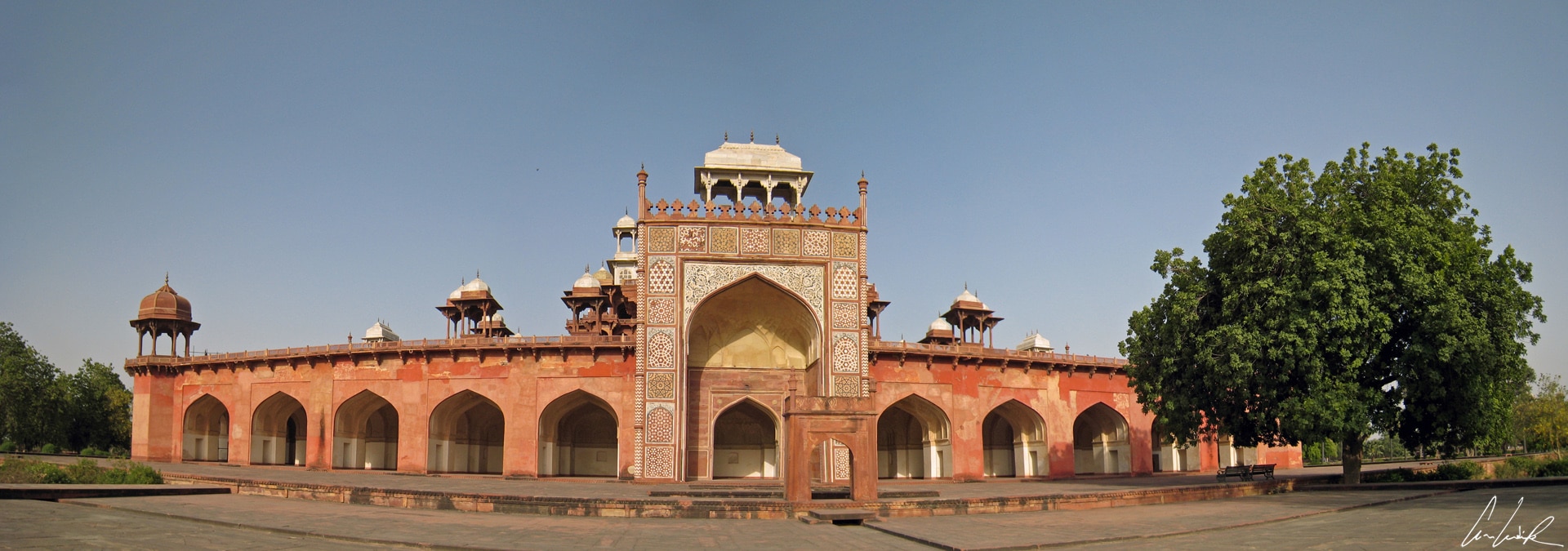
First stop 5 miles North of Agra at Sikandra, which is named according to Sultan Sikandar Lodi (1488-1516), the second Sultan of the Afghan dynasty who choose Agra as the capital in 1502. Beyond the south gate, the main entrance of Akbar’s tomb, very ornate in red sandstone and white marble with four towering white marble minarets, one at each corner, appears a vast park with gazelles and peacocks where calm and tranquility contrast with the “sound and fury” of the road. The Emperor Akbar the Great (1556-1605) began the construction of the colossal mausoleum around 1600. After his death, his son Jahangir completed the work between 1605 and 1613. Akbar the Great was one of the greatest Emperor of the Mughals. Akbar’s Tomb measures 22 meters high, built mainly from red sandstone, topped with an open air-garden courtyard enclosed on all four sides by white marble walls that seem almost reported. Among the decorations include the lotus flower (Buddhist symbol) and stone are carved following the Hindu techniques looking like wooden boards. Long arcades offer unexpected perspectives, but very photogenic!
Arrival in the city of Agra, located in northern India and 128 miles south of New Delhi, is the home to the iconic Taj Mahal. This city became the capital of the Mughal Empire in 1526. The golden age began with the reign of Akbar, and Jehangir & Shah Jahan that enriched the city with splendid architectural buildings in the Mughal tradition, most notably the Taj Mahal, the ultimate degree of perfection of Mughal art. The city was known as Akbarabad and was one of the largest city in India under the Mughal. After the decline of the Mughal Empire, Agra then loses its splendor and become a small provincial town of British India. The visit of the Agra Red Fort commissioned by the great Mughal emperor Akbar in 1565 and completed in 1574 is a must. The site is a UNESCO World Heritage along with the Taj Mahal and Fatehpur Sikri. The fort is surrounded by double castellated ramparts of red sandstone of 65 feet high and reinforced with towers. A 30-foot wide ditch and 33 feet deep surrounds the outer wall with cro cro cro, the cro cro cro, the crocodiles / on the banks of the Red Fort, they left, no need to talk any longer! We enter through the door of Amar Singh, a Maharaja executed on the site in 1644, then we follow the ramp for the elephants before discovering the Jahangir Palace in red ocher color and typically in Hindu style…

Then we discover other monuments with a more elegant architecture and less massive, including superb perspectives. White marble buildings inlaid with precious stones known as “pietra dura” consisting of geometric inlays of semiprecious stones in white marble, replacing the red sandstone, except the walls, gates, and towers. In the front of such beauty, even a native is moved! But the most prestigious monuments of Agra is still on the must-see list… For centuries, poets and travelers spread in praise of this bright pearl of India that is the Taj Mahal, whose the famous silhouette is the emblem country.


