

Wildlife Watching
Watching a wild animal starts with accepting that the animal decides. Reindeer and elk in Lapland, Atacama flamingos, coatis at Iguazu: this page gathers my wildlife watching stories, with my tips to enjoy these encounters in the right place, at the right time, without disturbing the ones you came to see.
Stories and tips from my travels watching wildlife
-
The 15 BEST Things to Do in Swedish Lapland in winter!
C-Ludik has selected 15 unique reasons to visit Swedish Lapland in winter ! Think icebreaker cruise, dog sledding, snowmobiling, and visiting the IceHotel, hunting the Northern Lights in Abisko National Park. Luleå winter walk on the frozen sea Walk or get a spark for kick-sledging on the famous ice road of Luleå called « Isbanan…
0 3 min read -

The top 10 Wild Animals to see in Lapland
Located beyond the Arctic Circle, Lapland offers endless natural landscapes and luxuriant wildlife. Watching wild animals in their natural habitat is part of a trip to Lapland.The vast forests, windswept Arctic hills, countless lakes, the Baltic Sea and its islands are home to unique wildlife. During part of the year, many wild animals and birds have…
0 16 min read -
 Costa Rica
Exploring the Costa Rican Pacific coast: the Manuel Antonio Park
The Parque Nacional Manuel Antonio is the smallest national park in Costa Rica. It lies on the Pacific coast, about 82 miles from the capital San José, and just south of Quepos. It is the most visited park in Costa Rica, was established in 1972 as a national park, and covers 7.66 square miles. It is…
0 14 min read -
 Costa Rica
Exploring the Costa Rican Pacific coast: the Carara National Park
The Carara and Manuel Antonio National Parks are both on the Pacific coast of Costa Rica. They have very different atmospheres: you can pick which one you want based on what you are looking for! The Parque Nacional Carara, the less known one, transitions from rainforest to tropical dry forest and has a very diverse…
0 9 min read -
 Costa Rica
Arenal Volcano National Park, a natural wonder
Costa Rica is a land of volcanoes. These volcanoes are part of the Central American volcanic arc and part of the Pacific Ring of Fire. Of the many volcanoes in Costa Rica, five are still active, Poás, Irazú, Arenal, Turrialba and Rincón de la Vieja. In the northwest of the country, Arenal is the most…
0 13 min read -
 Costa Rica
Head in the clouds at the Monteverde reserve
Monteverde (Green Mountain) Located in the province of Puntarenas is one place not to be missed in Costa Rica. It is Costa Rica’s most important ecotourism destination. In 1951, American Quakers from Alabama purchased land in Costa Rica and moved there to avoid the Korean War draft, which went against their pacifism. They were overwhelmed…
0 19 min read -
 Costa Rica
The Caño Negro Refuge: Pointed teeth and Feathers along the Water
The Refugio Nacional de Vida Silvestre Caño Negro, the largest wetland in Costa Rica, is located on the northern plains of the province of Alajuela near the border with Nicaragua. The reserve is remote and off the beaten path and tourist circuit. The closest village is Los Chiles to the northeast on the Rio Frío…
0 12 min read -
 Costa Rica
Tenorio Volcano National Park, the most wonderful of all
Once almost unknown, the Tenorio Volcano National Park in northwest Costa Rica is home to a unique natural treasure: a sublime turquoise blue river and waterfall unlike any other in Central America or in the rest of the world ! On the Guanacaste mountain range, not far from the northern end of Lake Arenal, the…
0 18 min read -
 Costa Rica
Fauna and flora of the Arenal Volcano National Park
How about a breath of fresh air in the heart of the Arenal Volcano National Park in Costa Rica ? This tiny Central American country is a vast nature sanctuary! The sumptuous Arenal Volcano National Park seduces in multiple ways: its omnipresent nature, its incredible biodiversity, its fauna, and especially its flora. The park was…
0 17 min read -
 Costa Rica
: A Vast Reservoir of Biodiversity
Costa Rica is a small country in Central America bordering Nicaragua to the North and Panama to the South. It is home to 5% of the planet’s biodiversity ! Out of two million species identified in the world today, about 91,000 are found in Costa Rica. In other words, nearly one species out of twenty…
0 22 min read -
 Eastern USA
Acadia National Park: A Park where the Mountains meet the Sea
National parks are much more than preserved wilderness. They have the power to stimulate our senses and make us feel alive. Their beauty offers an escape from the hustle and bustle of the world and the opportunity to experience extraordinary moments. As John Muir, the pioneer wilderness preservationist wrote, « Who has not felt the…
0 9 min read -
 Sultanate of Oman
Escapes in the Hajar Mountain Range
In the Sultanate of Oman, the landscape is tinted with three colors: ochre, the green of lush palm groves and the white of village houses embracing the mountain walls. Ochre is the dominant color and extends from the mountains to the desert and canyons. For geologists, these ochre lands hold many treasures. How can we…
0 11 min read -
 Sultanate of Oman
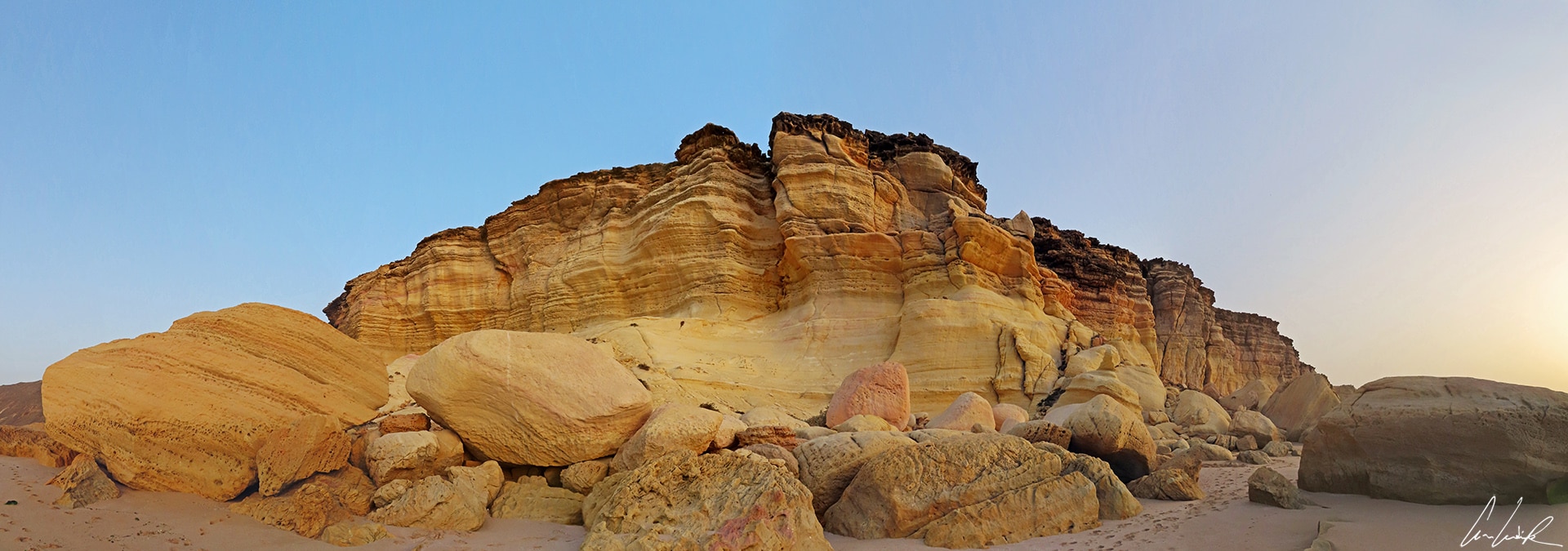
The East Coast of the Sultanate of Oman: A Walk along the Coastline
The coast of the Sultanate of Oman, at the eastern end of the Arabian Peninsula, offers many attractions. For millennia fishermen have navigated this long, pristine coastline of over 1,865 miles (3,165 kilometers.) The coast is lined with sand-colored forts built during the Portuguese colonization of the 16th century. Along the Arabian Sea vast deserted…
0 16 min read -
 Namibia
Walvis Bay: Rendezvous with Desert and Ocean
Located 22 miles from Swakopmund, the city of Walvis Bay (pronounced « vahl-fis bay ») is a rather unusual place. Travelers often hesitate to visit this small industrial port town, which is often covered by fog. However, it is an essential break in the journey along the long road to Sesriem. This corner of Namibia, trapped between the…
0 13 min read -
 Namibia
The Mysterious Skeleton Coast, and Cape Cross’ Fur Seals
After a long day driving through desert landscapes, we finally reach the ocean. Stunning waves of sand dunes undulate as far as the eye can see along the Atlantic Ocean. Here we are on the Skeleton Coast, the northern part of the Atlantic Coast of Namibia stretching south from the Kunene River on the border…
0 11 min read -
 Namibia
The Petrified Forest and Rock Carvings of Twyfelfontein
Let’s continue « Travelling Through The Wild Side » to the reggae music of Namibian musician Ras Sheehama and discover Damaraland, through its art and geology… « Travelling through the wilderness / I keep on travelling and travelling… / Through the wilderness » Travelling Through The Wild Side, Ras Sheehama Located in the northwestern part of the country…
0 14 min read -
 Namibia
Encounter with Desert Elephants and Welwitschia Mirabilis
The small town of Sesfontein and its surrounding area features unique fauna and flora. It lies in the Kunene region of northwestern Namibia between Kaokoland (Distant land) and Damaraland (Land of Damaras) and about 93 miles from the regional capital Opuwo. The name Sesfontein derives from the six springs which have their source in the…
0 14 min read -
 Namibia
Etosha National Park: A journey to the Animal Kingdom
For most people, African fauna consists of felines or the famous “Big Five”– the five African animals that all travelers dream of seeing and photographing. The expression “Big Five” does not refer to the animals of Africa that are the largest in stature, but big-game hunters created the term and to refer to the five…
0 15 min read -
 Namibia
In the heart of the Etosha National Park wildness
Namibia‘s animals consist of many species: 200 mammals, 645 birds, 250 reptiles, and more than 6,300 different insects. One-quarter of these are endemic to Namibia… It is also no secret that Etosha National Park is the best place to observe Namibian fauna, especially during the dry season from May to October. The status of the…
0 12 min read -
 Namibia
A glimpse of Etosha National Park
Namibia is a marvel for all those seeking distant new horizons… It is unthinkable to go to Namibia without going on a safari! Etosha National Park is one of the largest conservation areas in Africa and one of the best places to observe abundant wildlife roaming freely. The spectacular wildlife can be seen in complete…
0 13 min read
Page 1 of 3
Frequently asked questions about traveling watching wildlife
Watching is not ticking off. I spent two hours at an Etosha waterhole waiting for the zebras to arrive, and a whole night on an Omani beach waiting for thirty thousand green turtles that manage perfectly well without us.
Which animals live in Tenorio Volcano park in Costa Rica?
The green basilisk first, the one that runs on water. It moves at about ten kilometres an hour, pulling its foot back in under 25 milliseconds with a stride interval of roughly 70 milliseconds: that is the whole secret. You also meet the green anole, up to 80 centimetres of which two thirds is tail for 200 grams, the brown anole, the keel-billed toucan, the lineated woodpecker, the groove-billed ani and the Baltimore oriole, an inventory I keep in this walk beside the Rio Celeste. The nephila spider spans some ten centimetres and spins a web a metre across. For caimans and waders you have to head further north, into the Caño Negro refuge.
Which birds can you watch in Arenal Volcano National Park?
Around 500 species, that is 53 per cent of Costa Rican avifauna. The Montezuma oropendola hangs some thirty nests per colony, sometimes more than 170, and the noise they make gives the tree away before you see it. The Great Curassow reaches 85 centimetres for 5 kilos, the crested guan keeps higher, cattle egret and great egret hold the banks, which I set out in this inventory of Arenal wildlife. A toucan’s bill accounts for 30 to 50 per cent of its body surface and regulates its temperature across ten degrees, four times more efficiently than an elephant’s ears. The volcano itself is recounted in this natural wonder.
Which animals can you see in Etosha National Park in Namibia?
One hundred and fourteen mammals and three hundred and forty birds recorded. In the dry season everything converges on the waterholes: zebra, kudu, giraffe and elephant take turns in waves, each making room for the next. Zebras carry white stripes on a black ground, asymmetric and specific to every individual. Giraffes sleep two hours and put out a tongue of 45 to 50 centimetres; lions sleep fifteen, which I checked through binoculars in this stay in the heart of the wildness. Black rhino differ from white by the lip, and their calves walk one behind the mother, the other in front. Buffalo, meanwhile, are missing, which my journey to the animal kingdom explains.
Which animals can be watched in Acadia National Park?
Forty mammal species and more than 350 bird species. On the ground: white-tailed deer, moose, beaver, chipmunk, North American porcupine, coyote, fox and black bear. In the air, the black-capped chickadee holds the role of Maine emblem. Two residents are worth stopping for: the common loon, which dives to twelve metres and holds three minutes underwater, and the monarch butterfly, capable of more than 3 200 kilometres of migration, an inventory I keep in this Maine notebook. Cougar and grey wolf have gone from the region. For bison rather than moose, go and see my safari in Custer State Park.
How do flamingos live on the edge of the Atacama desert?
By filtering lagoons whose salinity makes them uninhabitable elsewhere. Three species share the salar and are known by their legs: the Chilean flamingo with grey legs and red joints, the Andean one with yellow legs and black wingtips, the James flamingo with a yellow bill tipped in black. The Chaxa, Barros Negros, Salada and La Punta lagoons form the core of Los Flamencos National Reserve, the first co-management between the Chilean state and the Lickan Antai people, which I recount in this life in pink beside the salar. In Namibia the salt pans of Walvis Bay, 5 000 hectares yielding 700 000 tonnes a year, host the largest colony in southern Africa, in this meeting of desert and ocean.
What is the best time of year for watching wildlife?
The dry season, everywhere, with no notable exception. The principle is simple. When water grows scarce, animals concentrate where it remains, and the watcher stops chasing them. In Namibia the window runs from May to October and turns every waterhole into a compulsory crossroads, which my vigil at the Etosha waterholes shows. In Costa Rica the logic changes shape: at Caño Negro, a reserve of 100 square kilometres created in 1984 and the country’s first RAMSAR site in December 1991, it is the migrants of January to March who make the season, which this navigation on the Rio Frio recounts.
How can you watch wild animals without disturbing them?
Stay far, stay low, and accept missing the shot. At Cape Cross, a reserve of 60 square kilometres, lives the largest of the 23 fur seal colonies of southern Africa: males reach two metres for 350 kilos, pups are born in November and December, and a quarter of them do not see out the year. You watch from the walkway, never from the beach, which I explain in this passage along the Skeleton Coast. At Ras al-Jinz, a reserve declared in 1996, the night outing is supervised: around 30 000 green turtles come to lay there each year, as described in my night on the Omani coast.
Check out our other themed trips
-

Autumn travel: Best Destination for Fall
Autumn gives the trails back their silence: colors take over from the crowds, the light softens and destinations finally breathe again. This page gathers my… -

Best places to visit in Winter
Winter is my season: white forests in Lapland, dog-sled safaris, northern lights and Icelandic winters. This page gathers all my winter travel stories and… -

Best Summer Holiday Destinations
Summer opens up the wide spaces: the midnight sun in Lapland, Icelandic summers, hiking trails and evenings that never seem to end. This page gathers my… -

City Walks
A city reveals itself on foot, or not at all. From Shanghai to Valparaiso and on to New Orleans, this page gathers my favorite city walks: neighborhood routes… -

Desert Travel Experiences Around the World
No two deserts are alike: the dunes of the Wahiba Sands, the expanses of the Namib, the salt and lagoons of the Atacama. This page gathers my desert travel… -

Most Beautiful National Parks in The World
A national park is best told from the trail, not from the map. From Torres del Paine to Abisko by way of Etosha, this page gathers my national park stories… -
Spring best places to travel
Spring is the season travelers overlook, and that is a mistake: days grow longer, nature wakes up and the crowds have not arrived yet. This page gathers all my… -

The Best Islands to visit
An island sets its own pace: you arrive by sea or by air, and everything that follows belongs to it. From Madeira and Cape Verde all the way to Easter Island…

Hello, I am C-Ludik, a traveller with a passion for nature and photography. Travel is far more than moving from one destination to another.
It is an invitation to slow down. To watch the last light of day settle on a quiet village, to wait for an animal to appear on the horizon, to listen to the distant roar of a waterfall or to be surprised by a landscape where you least expect it.
Through ’Tween Here and There, I share the stories, photographs and emotions gathered along the way. From the deserts of Namibia to the Himalayan peaks, from European villages to the far shores of the Pacific, each journey becomes a story to tell and an invitation to see the world differently.
With camera in hand, I invite you to follow me along winding roads and remote trails, towards the places, the light and the encounters that turn a simple trip into a lasting memory. Because the greatest adventures sometimes begin far away (there)… and sometimes right at home (here). Welcome to my five-senses odyssey across the world, where distant horizons meet the wonders of everyday life.
Every journey is far more than a destination. It is a collection of encounters, light and emotions that I am delighted to share through my photographs and travel stories.
Lire en français


Travel by Theme