

Singapore
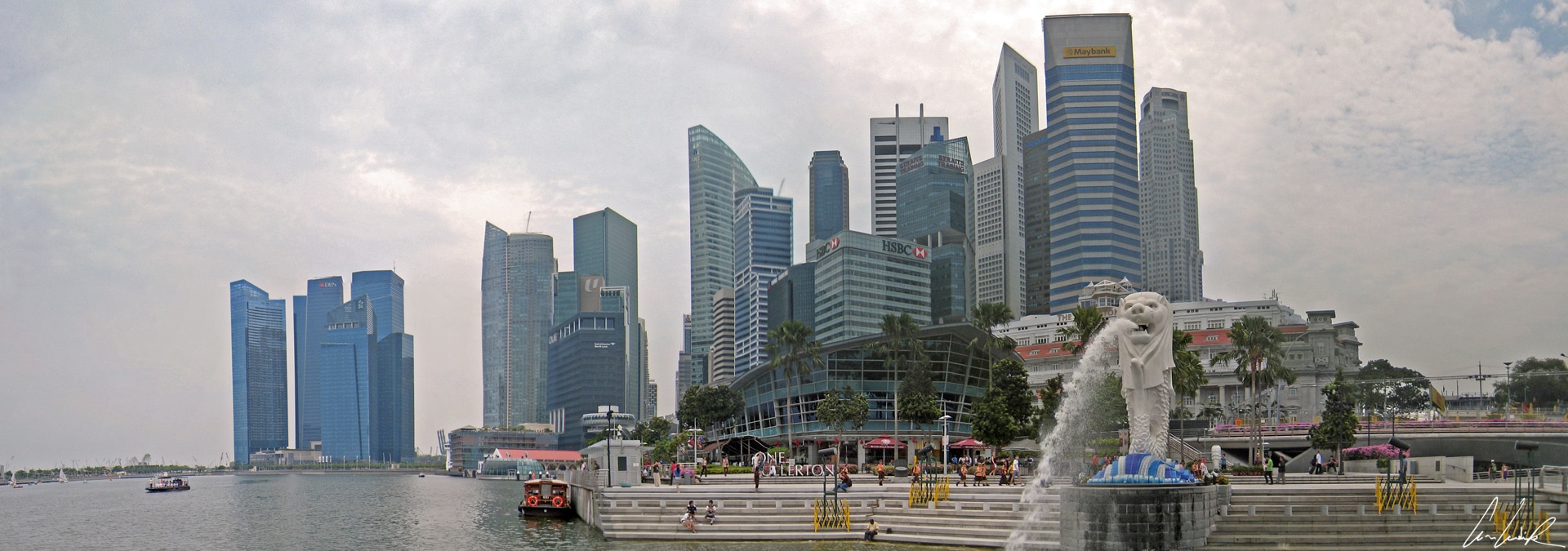
A city-state perched at the tip of the Malay Peninsula, Singapore first reads like a futuristic megalopolis in a subtropical climate: it’s hot, above 85°F, and humid, with those heavy downpours that fall almost every day yet never linger. Nicknamed The Green City, it lets nature slip in everywhere, at the foot of the skyscrapers and even onto their rooftops — that’s the dizzying part of this race toward the outsized. In Malay, Singapore means “the Lion City,” and the Merlion, a statue with a lion’s head and a fish’s body, keeps watch over the bay facing the business district. For me, this corner of the world was part of a wider travel in Asia, between the fervor of temples and feats of architecture.
Above Marina Bay, the three towers of Marina Bay Sands lift the SkyPark to 738 feet, with its infinity pool hanging above the city. A bit farther on, the ArtScience Museum opens its lotus-shaped bloom over the water, and the Singapore Flyer tops out at 540 feet, the tallest in the world. But the one place I wouldn’t skip for anything is the Gardens by the Bay: when the crowns of the artificial trees come into view, another world seems to open up, straight off the planet Pandora.
Once you’ve had your fill of buildings, Singapore shows a second face in its ethnic quarters. On Arab Street, a maze of colorful houses stretches beside the great Sultan Mosque, in the scents of perfume and incense rising from golden burners. A few streets over, Little India is something to look at, breathe in, and listen to: spices, bright saris, spellbinding rhythms, a kopi ho on a terrace. And then Chinatown, its lanterns, its market, and its Buddha Tooth Relic Temple, where you come across the ever-present Xiangqi, the Chinese chess also called “elephant chess.”
As the calendar had it, I was there during the Mid Autumn festival, the lantern celebration tied to Chang E, goddess of the Moon. The streets, the bridges, and gardens like the Chinese Garden glittered with thousands of paper lanterns — fish, Lions, Dragons, Swans, little marvels of creativity. On the festival menu, Mooncakes, barely 3 inches across but with a heft that surprises you in the hand: better to look at than to bite into.
Stories and tips from my travels in Singapore
-
 Singapore
The garden city and its magic lanterns
Sated with futuristic buildings, we find another side of Singapore when walking down the streets of its ethnic neighborhoods. Arab Street, a small shopping street, is a labyrinth of colorful houses, bustling day and night and quite near the must-see Sultan Mosque with its massive golden domes. The mosque, the largest religious building in Singapore,…
22 5 min read -
 Singapore
On the narrow streets of Singapore…
Ladies and gentlemen, Let’s explore a city, a country, and an island by visiting only one place: Singapore, located off the coast of Southern Malasia. The Asian city-state known as “The Garden City” is a global commercial, financial and transportation hub with tall skyscrapers divided by green space, allowing visitors and locals to breathe while…
26 7 min read
Frequently asked questions about traveling in Singapore
A city that fits on an island, with two faces: the three so-called ethnic districts on one side, the bay and its supertrees on the other. In between sit four official languages, a festival pastry and a coffee you have to know how to order.
What do you see in the narrow streets of Singapore?
Three so-called ethnic districts, all walkable. Arab Street first, where the Sultan Mosque, the largest in the city, was raised in 1825. Little India next, with the Sri Veeramakaliamman temple built in 1885 and the Majid Abdul Gafoor mosque, completed in 1910 and restored since. Chinatown last, home to the Buddha Tooth Relic Temple and the place where I buy my souvenirs: that is the route through Arab Street, Little India and Chinatown. Little India is looked at, breathed in and listened to, and the best move is to sit down at a cafe terrace and take in the moment. It all happens on foot. The rest of my stops are in my travels in Asia and the Middle East.
What is a mooncake and when do people eat it?
A pastry of the Mid Autumn Festival, roughly 8 centimetres across and 3 centimetres high. The paste is made from lotus, sweet beans or figs, and the mould prints patterns so crisp that you hesitate before cutting into the cake. My verdict, once tasted: you do not much want to eat it, because it looks better than it tastes. The lanterns of that festival are set out in the Chinese Garden, an evening told in my evening of magic lanterns. You also come across players of Chinese chess there, a game that lines up 16 pieces per player, including 1 General, 2 Mandarins and 2 Elephants. The traditions of the neighbouring giant sit in my Chinese travel stories.
What can you see from the top of Marina Bay Sands?
The SkyPark, perched 225 metres up. Marina Bay Sands is made of 3 towers of 57 floors, built and opened in 2010, and the platform linking them covers 1.2 hectares with 250 varieties of trees and 650 varieties of plants, the viewpoint that opens my walk around the bay. The infinity pool runs 150 metres long and holds 1.4 million litres of water. From up there you pick out the Esplanade, the performing arts centre whose shape recalls two durians, the Art Science Museum shaped like an open tulip, and the city big wheel. It rises a hundred and sixty-five metres, against a hundred and thirty-five for the London one. The palaces of the subcontinent are in my Indian travel stories.
What are Gardens by the Bay and its supertrees?
Gardens by the Bay: over 100 hectares, opened in late June 2012. It houses around 200,000 plants brought from every continent, which makes it a botanical inventory as much as a place to stroll. The famous supertrees number eighteen and stand between 25 and 50 metres high; eleven of them run without any external energy supply. A walkway suspended 25 metres above the ground connects them, and that is where the city takes its full measure, as shown in the supertree walkway route. The Merlion, a statue with a lion head and a fish body, remains the symbol of the place nicknamed The Green City. The Himalayan heights wait in my Nepal trekking stories.
How do you order a coffee in Singapore without getting it wrong?
Ask for a kopi, not a coffee. The difference matters: say coffee please and you are served a coffee with sweetened condensed milk, whereas the traditional local brew is called kopi. For the iced version, add peng, and you get a kopi peng, which is what I order as soon as the heat turns serious. In Little India it was a kopi ho that I took on a terrace, watching the district go by, a small lesson in vocabulary that comes from the counter words across Asia. Three words are enough at the counter. The big neighbour to the north is told in China from Fujian to Shanghai.
Which languages are spoken in the streets of Singapore?
English, Mandarin, Malay and Tamil. All four are heard as you move between districts, and you have to add Singlish, a Singaporean English tinted with Mandarin that surfaces as soon as a conversation picks up speed. That same mixture is what you find from one district to the next, between Arab Street, Little India and Chinatown. Tamil itself comes from the subcontinent I walk in the India of the golden triangle. Sentosa, whose name means peaceful island in Malay, gives another example of it. The language is heard again in the courtyards of the mausoleum I visit in a morning at the Taj Mahal.
What is the weather like in Singapore and what is there on Sentosa?
Over 30°C, with 56 per cent relative humidity. Rain falls almost daily, but in showers that seldom last more than an hour, which leaves plenty of room to get out between two of them. Sentosa, the island park reached by monorail, works as a release valve: it holds 4 amusement parks, including Universal Studios Singapore, along with beaches, an aquarium, a butterfly park, a zoo, a toboggan run and a wave simulator. You go for the day. For a desert climate rather than a humid one, see my escapes across the Sultanate of Oman. On the city markets, by contrast, I came across live eels and turtles, and frogs as well. And for the dry altitude of Mustang, read the trek to the land of dzos.
The countries of Asia and Middle East I have travelled
-


China
From the Hakka earth houses to Shanghai's lit-up skyscrapers, Fujian gave me Oolong tea, rice paddies, and a sense of time frozen for centuries. -


India
I went to meet the Taj Mahal in an orange sari, a star for a day. In India you don't visit: you get seized, caught between splendor and dust. -

Nepal
From the Fokker leaping from 2,700 to 9,200 feet to Mustang's red desert, I walked to the rhythm of happy wanderers. Prayer flags snap in the wind that dehorns the dzos. -


Sultanate of Oman
Land of frankincense and Sinbad the Sailor, the Sultanate of Oman blends shifting deserts, dizzying canyons and sand-colored forts. I found deep quiet in its wadis, far from the Gulf's obsession with scale.

Singapore is a place where nature meets the future. From the iconic skyline of Marina Bay to the futuristic Gardens by the Bay, every journey reveals a city that has found a rare balance between innovation, culture and nature.
What fascinates me most is the harmony found throughout the city. Towering skyscrapers rise beside lush gardens, long-standing traditions coexist with cutting-edge architecture and every neighbourhood reveals a different facet of Singapore’s identity.
Photography has taught me to appreciate these contrasts. The reflections of Marina Bay at sunset, the illuminated Supertrees glowing against the night sky or the soft light of paper lanterns in the Chinese Garden create moments that feel both modern and timeless.
With camera in hand, I invite you to explore Singapore through its architecture, its gardens and the atmosphere that sets it apart from any other city.
Every journey is far more than a destination. It is a collection of encounters, light and emotions that I am delighted to share through my photographs and travel stories.
Lire en français


Travel by Theme